

ACFM vs. SCFM: Why Standard CFM Will Mislead Your Vacuum Pump Sizing

In compressed air operations, volumetric flow rate is typically measured in Standard Cubic Feet Per Minute (SCFM), defined under standard temperature and pressure conditions (68°F, 36% relative humidity at sea level). However, when sizing equipment for vacuum applications, relying strictly on SCFM is one of the most common and costly mistakes an engineer can make.

The Physics of Air Expansion
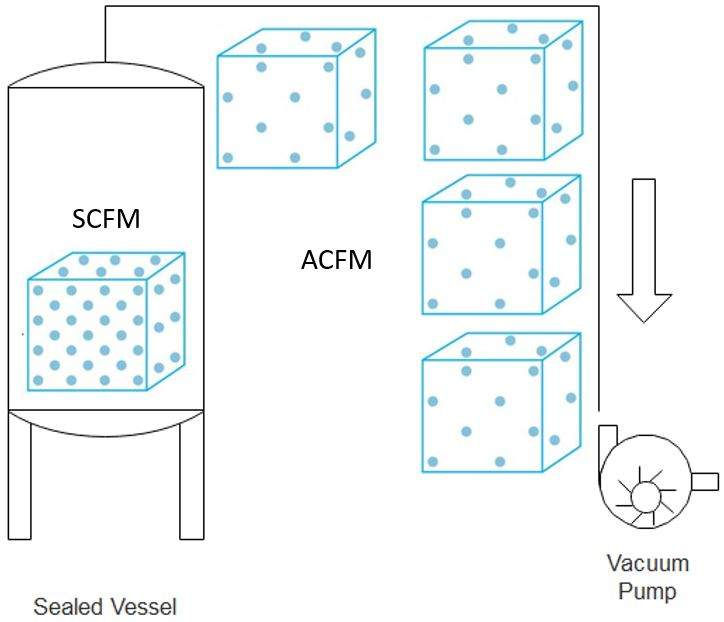
Unlike compressed air, air under vacuum expands significantly as operating pressure drops. Actual Cubic Feet Per Minute (ACFM) represents the true volumetric flow rate that the vacuum pump must handle at its specific operating vacuum level. Because air molecules move farther apart under vacuum, ACFM is always equal to or greater than SCFM.
To visualize this, consider a gas volume passing through a system at different vacuum depths:
At 0 in-HgV (Atmospheric Pressure): 10 SCFM equals 10 ACFM.
At 20 in-HgV: The air expands 3-fold; 10 SCFM becomes 30 ACFM.
At 25 in-HgV: The expansion reaches 6-fold; 10 SCFM expands to 60 ACFM.
Why Pump Selection Fails
If a process requires pulling 100 SCFM at a deep vacuum of 25 in-HgV, selecting a pump rated for 100 CFM without distinguishing between standard and actual conditions will result in a severely undersized pump. The pump will fail to reach or maintain the required process vacuum depth.
This is why all reputable vacuum pump performance curves are reported in ACFM, reflecting the actual expanded cubic feet per minute entering the pump inlet.
EW Klein Technical Tip
When evaluating replacement pumps or expansion lines, always convert process mass flow or SCFM requirements into ACFM at the specific operating vacuum level before checking pump curves.
Need assistance calculating ACFM conversions or selecting the right pump curve? Contact the application specialists at E.W. Klein & Co.

Comments